Development
Autism, ADHD and early signs
Some features can be recognised in the second year, assessment routes vary, and early support does not require a diagnosis.
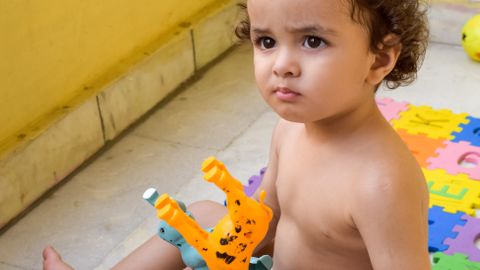
Parents frequently notice differences long before anyone will say anything, and knowing what the recognised early features are — and what to do about them — is genuinely useful.
Early features associated with autism
Which are observable in some children in the second year, and which individually mean little.
Reduced response to their name by around twelve months.
Limited or absent pointing to share interest — showing something because it is interesting, rather than to request it.
Reduced following of another person's point or gaze.
Limited eye contact, or eye contact used differently.
Less back-and-forth social interaction, smiling and imitation.
Delayed or unusual language, including loss of words.
Repetitive movements such as hand flapping, spinning or toe walking.
Intense interest in particular objects or parts of objects, and lining up or ordering things.
Distress at changes in routine.
Unusual sensory responses — to sound, texture, light, taste — either seeking or avoiding.
And reduced pretend play by around two years.
None of these individually indicates autism; a pattern across several is what prompts assessment.
ADHD
Which is not diagnosed in infancy.
Assessment generally occurs from school age, because the features — high activity, impulsivity, short attention — are developmentally normal in toddlers.
What can be observed earlier is a degree of activity, impulsivity and difficulty with regulation that is markedly beyond peers and that persists across settings.
Early difficulty with sleep, feeding and regulation is more common in children later diagnosed, and is not predictive individually.
What warrants referral regardless of label
The practical thresholds.
Loss of any previously acquired skill, at any age, which always warrants prompt assessment.
Not responding to name by around twelve months.
No pointing to show by around eighteen months.
No single words by around eighteen months, or no two-word phrases by around two years.
No pretend play by around two years.
And parental concern, which is a recognised and valid reason on its own — studies consistently find parental concern to be a reasonable predictor.
The assessment route
Which varies by country and is generally slow.
The first step is usually a health visitor, general practitioner or paediatrician.
Hearing should always be tested, since hearing loss produces overlapping features and is easily excluded.
Speech and language therapy assessment is frequently part of it, and in many places accepts self-referral.
Diagnostic assessment for autism is typically multidisciplinary and involves observation, developmental history and standardised tools.
Waiting lists are long in many systems, which is why the next section matters.
Support does not require a diagnosis
The most useful thing in this article.
Speech and language therapy, occupational therapy input, early years support and educational adjustments are frequently available on the basis of need rather than diagnosis.
Early intervention approaches focused on parent-mediated interaction have evidence for improving social communication, and can begin while waiting.
Nursery and childcare settings can implement adjustments without a label.
And practical strategies — visual routines, warning before transitions, reducing sensory load, following the child's interest in interaction — help many children regardless of whether any diagnosis follows.
What to be cautious about
An area with an unusually large market.
Interventions promising recovery or cure from autism, which are not supported and which include some that are actively dangerous — chelation, restrictive protocols and unproven biomedical treatments among them.
Dietary exclusions without evidence, which risk nutritional harm.
Expensive intensive programmes with weak evidence.
And any provider who dismisses professional assessment.
The reasonable position: seek evidence-based support through health and education services, and treat commercial claims with scepticism proportional to their promises.
The framing
Worth thinking about.
Autism is a difference in how a person processes the world rather than an illness, and autistic adults have been clear that support should focus on communication, accommodation and wellbeing rather than on making a child appear less autistic.
Which shapes what good support looks like: building communication in whatever form works, adjusting environments, and addressing genuine difficulties such as sleep, anxiety and sensory distress.
A diagnosis is a route to understanding and support rather than a verdict, and for many families it explains a great deal that was previously confusing.
General information only, not medical advice. Consult your health visitor or a qualified clinician about developmental concerns — parental concern is a valid reason for assessment.
Also by Dr Nina Castellanos
- Colds, coughs and what to giveHealth & Safety
- Rashes and what they meanHealth & Safety
- The six-to-eight week reviewNewborn Care
- Hygiene, germs and how much to worryHealth & Safety