Sleep
Travelling and holidays with a baby
Sleep, feeding and safety all need adjusting, and the preparation determines whether it is a holiday or a relocation of the difficulty.

Travelling with a baby is entirely doable and requires accepting that the trip will be different from the one you would have taken before.
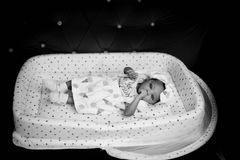
Sleep away from home
The main disruption.
Bring what is portable and familiar: the sleeping bag, the comforter, the same bedtime routine in the same order.
A travel cot works better if the baby has slept in it at home a few times beforehand.
Darkness is the variable most often overlooked — portable blackout material makes a substantial difference in a bright hotel room or a summer holiday.
White noise helps mask unfamiliar sounds.
Expect several disrupted nights and a settling period on return, which is normal.
And apply the same safe sleep principles wherever you are: a clear, flat, firm surface with nothing in it, which frequently means not using what the accommodation provides.
Flying
Practical points.
Infants under two usually travel on a lap with a supplementary belt, and buying a separate seat with an approved car seat is safer where affordable.
Feed or offer a dummy during ascent and descent to help with ear pressure, which is the main source of distress.
Cabin air is dry, so offer fluids frequently.
Airlines vary in what they allow for liquids for infants; formula, expressed milk and baby food are generally permitted above normal limits with screening.
Bring more nappies, wipes and spare clothes than seems reasonable, plus a change of top for yourself.
Bassinets on long-haul flights must be requested in advance and have weight limits.
And boarding early or late is a genuine choice: early gives time to settle, late reduces time on board.
Car journeys
Where the safety points matter most.
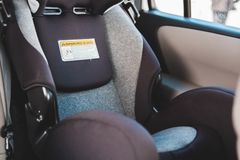
Limit continuous time in a car seat, with guidance commonly citing around two hours before a break, particularly for young infants whose airways can be compromised in the semi-upright position.
Never leave a child alone in a car, where temperatures rise rapidly and lethally.
Check the car seat installation before a long journey, and do not use a seat that has been in a collision.
Sunshades that attach to windows are safer than stick-on films that obstruct vision.
And plan for the journey to take considerably longer than it would without a baby.
Time zones
Where realism helps.
For short trips of a few days, staying on home time is frequently easier than adjusting twice.
For longer trips, adjust on arrival using light: daylight in the morning at the destination to shift earlier, evening light to shift later.
Feed and nap on local time from the first day.
Expect several days of adjustment, roughly a day per time zone, and expect the return to be harder if travelling east.
Health preparation
The part most often left late.
Check whether travel vaccinations or malaria prophylaxis are needed and whether they are suitable for the child's age, well in advance since some require courses.
Check routine vaccinations are up to date.
Take a basic kit: infant paracetamol and ibuprofen, oral rehydration sachets, a thermometer, plasters, antiseptic, insect repellent suitable for the age, and any regular medication with a prescription copy.
Arrange travel insurance that covers the baby.
Find out where the nearest medical facility is at the destination.
And check documentation requirements, since babies need their own passport and in some cases a visa.
Sun and heat
Where infants are particularly vulnerable.
Babies under six months should be kept out of direct sunlight entirely, using shade, clothing and hats rather than sunscreen as the primary measure.
For older babies, high-factor sunscreen suitable for children, applied generously and reapplied.
Babies overheat quickly and lose fluid faster than adults, so offer feeds more often in heat.
Avoid the middle of the day.
Watch for signs of overheating: flushed, hot, unusually sleepy or irritable, fewer wet nappies.
And a pram covered with a blanket becomes dangerously hot inside, which is a well-documented hazard — use a clip-on shade or a purpose-made cover that allows airflow.
Food and water
In destinations where water safety is a concern.
Use bottled or boiled water for formula preparation, still boiled to the correct temperature.
Breastfeeding is the simplest option while travelling for exactly this reason.
Avoid ice, unpeeled fruit, salads washed in local water and unpasteurised dairy where advised.
And take oral rehydration sachets, since gastroenteritis in an infant dehydrates them fast and is the most likely travel illness.
General information only, not medical advice. Consult a travel clinic or clinician about vaccinations and destination-specific advice for infants, and seek medical care promptly for a baby who becomes unwell abroad.