Development
Play, and what babies actually need
The developmental value is in the interaction and the exploration rather than in the toy, which is fortunate.
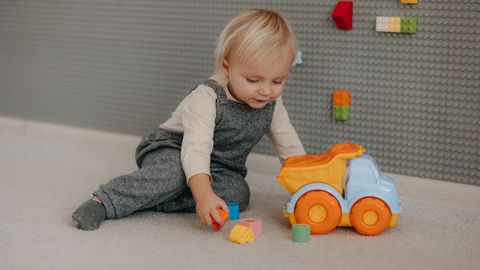
The market for developmental toys is enormous, and the research on what supports early development points overwhelmingly at things that cost nothing.
What play does
It is how children learn about cause and effect, object permanence, physical properties, spatial relationships, language and social interaction.
It builds motor skills through repetition.
It develops attention and persistence.
And it is the context in which the responsive adult interaction that drives development takes place.
Which is why the adult matters more than the object.
What babies play with at each stage
Roughly.
Newborns: faces, voices, high-contrast patterns, being talked to and held.
Two to four months: hands, reaching, batting at things, mirrors.
Four to six months: grasping, mouthing everything, transferring objects, cause and effect toys.
Six to nine months: banging, dropping things repeatedly to see what happens, containers, peekaboo, which is object permanence in action.
Nine to twelve months: putting objects in and out of containers, simple stacking, pointing, imitation.
Twelve to eighteen months: pushing and pulling, posting shapes, scribbling, simple pretend play beginning.
Eighteen months onward: pretend play developing rapidly, simple problem solving, more sustained attention.
The best toys
Consistently the least sophisticated.
Boxes, containers, tupperware, wooden spoons, cups, scarves, blankets.
Balls.
Blocks, which support spatial reasoning and which research has linked to language when adults talk during block play.
Books.
Anything that can be safely filled, emptied, stacked, banged or posted.
The principle is that open-ended toys, which can be used in many ways, sustain interest and support more varied play than electronic toys that do one thing.
Studies comparing electronic toys with traditional toys and books have found less adult–child talk during electronic toy play, which matters given how language develops.
Fewer toys
A finding worth acting on.
A study of toddler play found that with fewer toys available, children played with each for longer and in more varied and creative ways.
The interpretation is that too much choice fragments attention.
The practical version is rotation: keep a proportion of toys out of sight and swap them periodically, which reduces clutter and restores interest without buying anything.
What to look for in what you do buy
Safety first: age-appropriate, no small parts for anything a baby will mouth, no button batteries accessible, no long cords or ribbons, and conforming to relevant safety standards.
Button batteries deserve particular emphasis, since swallowing one causes severe internal burns within hours and is a genuine emergency.
Beyond safety: open-ended, durable, and usable in more than one way.
Avoid anything requiring the child to be passive.
Outdoor play
Underrated for babies.
Time outdoors is associated with better sleep, more physical activity, and — in the myopia literature — protection against short-sightedness in later childhood.
Babies benefit from being outside daily, in the pram, in a sling, or on a blanket.
Older babies benefit from varied surfaces to crawl and walk on, which develops balance and proprioception in ways a flat carpet does not.
And the adult benefits too, which is not a trivial consideration.
Play that adults find boring
Worth naming, since nobody says it.
Playing with a baby is frequently monotonous, and finding it so does not make you a bad parent.
Babies do not need continuous entertainment, and independent play — a baby exploring safely nearby while an adult does something else — is valuable and builds concentration.
Narrating what you are doing while you do something else counts as interaction.
And short bursts of full attention are worth more than long periods of distracted presence.
Reading
The single highest-return activity.
Shared book reading in infancy is associated with language, vocabulary and later literacy outcomes.
Babies do not need to sit still, do not need to look at the page, and do not need the words read as written.
Talking about the pictures, letting them turn pages and chew the book, and reading the same book repeatedly are all appropriate.
Board books, cloth books and books with textures work for young babies.
And libraries make this free, which is worth saying given the price of children's books.
General information only, not medical advice. Consult your health visitor about developmental concerns, and follow safety guidance on toys — seek emergency care if a button battery is swallowed.