Sleep
White Noise, Darkness And The Sleep Environment
Sound and light both act on how easily a baby surfaces from sleep, and the practical measures follow from what each one does physiologically.

Sleep environment advice tends to arrive as a list of tips. Each element works through a specific mechanism, and knowing which one clarifies how much any of it matters.
Why darkness affects sleep timing
Light detected by the retina reaches the body clock directly and suppresses melatonin release. Evening light therefore delays the biological signal for night.
Darkness during sleep removes that suppression and supports the timing already established. It does not itself cause sleep, but it stops working against it.
Morning light does the opposite job, advancing the clock. Exposure at the right end of the day is as useful as darkness at the other.
What white noise actually does
Sudden sounds cause arousal because the brain monitors the environment during sleep and reacts to change. It is the contrast against silence that wakes, not the absolute volume.
Continuous sound raises the background level so that a door closing or a car outside represents a smaller relative change. The trigger is masked rather than removed.
This is why constant, unvarying sound works better than music or anything with structure, which contains changes of its own.
Volume limits and why they exist
Infant hearing is sensitive and continuous loud exposure over long periods carries risk. Guidance generally recommends keeping devices at a modest volume and away from the cot.
Devices vary considerably in output at the same setting, and some produce more than expected at maximum. Placement across the room reduces exposure substantially.
Sound that runs all night is a stronger association than sound used only at settling, which is worth considering before it becomes hard to travel without.
Temperature and the sleep drive
Core body temperature falls as sleep begins, and a cool room supports that drop. An overheated room works against it.
Overheating is also a recognised safe sleep risk factor, which is why guidance specifies a room temperature range and cautions against excessive layers.
Hands and feet normally feel cool in babies, so temperature is checked at the chest or the back of the neck instead.
What the environment cannot do
None of these measures shortens sleep cycles or removes the surfacing that occurs between them. They reduce the chance that a surfacing becomes a waking.
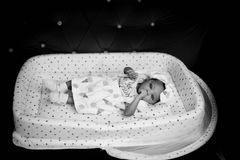
The cot itself must meet safe sleep guidance, which takes priority over any comfort measure. Firm flat surface, no loose bedding, and the baby on their back.
Persistent poor sleep despite a good environment, particularly with snoring, breathing pauses or daytime exhaustion, deserves a medical opinion rather than more equipment.