Development
Tummy time, rolling and flat heads
The back-to-sleep advice saved many lives and produced a predictable side effect with a straightforward answer.
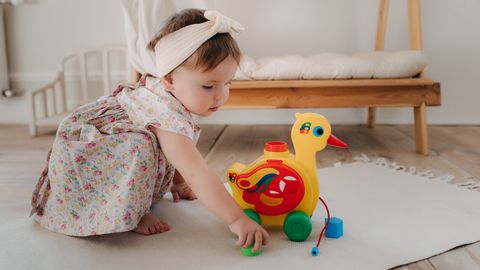
Positional flat head became substantially more common after back sleeping was universally recommended, which is an entirely acceptable trade given what back sleeping prevents — and it is largely preventable in itself.
Why tummy time matters
Babies who sleep on their backs and spend waking time in car seats, bouncers and swings spend very little time on their fronts.
Time on the tummy while awake develops neck, shoulder and trunk strength, which underpins head control, rolling, sitting and crawling.
It also relieves pressure on the back of the skull, which is soft and moulds in response to sustained pressure.
Studies have associated limited tummy time with delayed attainment of some motor milestones, which is not the same as long-term harm and is a reason to do it.
How to do it
Start from the first weeks, at home, while awake and supervised.
Begin with very short periods — a minute or two — several times a day, and build up gradually towards an hour in total spread across the day by around three months.
Immediately after a nappy change is an easy anchor.
Avoid straight after a feed.
Get down at their level, face to face, since a baby will tolerate far more with a face to look at.
Use a mirror, a high-contrast toy or a rolled towel under the chest for support.
Chest-to-chest on a reclined adult counts and is frequently the way to start with a baby who objects.
Lying across a lap counts too.
When they hate it
Very common and not a reason to abandon it.
Try shorter and more frequent sessions.
Try after a nap rather than when tired.
Try the incline and lap positions before the floor.
Try a side-lying position, which is easier and still builds the relevant strength.
And persist, since tolerance builds with exposure and a baby who has done very little at eight weeks will object more, not less, at twelve.
Persistent distress, arching or difficulty turning the head one way should be mentioned, since it may indicate torticollis or reflux.
Flat head
Positional plagiocephaly — flattening on one side — and brachycephaly — flattening at the back — are common and are cosmetic rather than affecting brain development, which is the reassurance most parents want and rarely receive plainly.
Most improves substantially as the baby becomes mobile and spends less time lying down, and skull shape continues to improve into the second year.
Prevention and management: plenty of tummy time; alternating the head position during sleep by changing which end of the cot the baby's head is at, since babies turn towards the room; alternating the arm used for feeding; limiting time in car seats and bouncers; and carrying more.
Helmet therapy is offered in some settings for severe cases; evidence is mixed, with at least one randomised trial finding no significant difference compared with natural course, and it is generally reserved for severe deformity after conservative measures.
Torticollis
Worth knowing because it is the treatable cause behind many flat heads.
Congenital muscular torticollis involves tightness in one of the neck muscles, causing a persistent head tilt and preference for turning one way.
It responds very well to physiotherapy, particularly when started early, and it is the reason a baby always looks one way and develops flattening on that side.
A persistent head tilt, restricted turning, or always feeding better on one side should be raised.
Rolling
Generally begins between four and six months, frequently front to back first.
Once rolling begins, several things change.
Swaddling must stop entirely, since a swaddled baby who rolls cannot use their arms.
Never leave a baby unattended on a raised surface, at any age, since the first roll is always unexpected.
And if a baby placed on their back rolls onto their front during sleep, they can be left, provided they have been placed on their back and the sleep space is clear.
Equipment
Where less is better.
Baby walkers are advised against by paediatric bodies in several countries and are banned in one, on the basis of injury risk and no developmental benefit.
Bouncers, swings and seats are useful in moderation and become a problem when they are where the baby spends most of the day.
Jumpers and door bouncers should be limited.
The best equipment for motor development is a flat surface, a bit of space and an adult on the floor, which costs nothing and is the thing most often skipped.
General information only, not medical advice. Consult your health visitor or a qualified clinician about head shape, head tilt or motor development concerns.
Also by Dr Nina Castellanos
- Colds, coughs and what to giveHealth & Safety
- Rashes and what they meanHealth & Safety
- The six-to-eight week reviewNewborn Care
- Hygiene, germs and how much to worryHealth & Safety